
Why We Care About Age (And Why It Shapes How We Work)
2 minute read…
Age is one of the most misunderstood forces in modern marketing.
It’s often treated as a demographic input. A line on a slide. A shorthand for taste, language, and behaviour. Gen Z. Millennials. Boomers. Useful labels, perhaps, but rarely sufficient. What they often miss is that age is less about identity and more about context. I make this mistake sometimes too.
At Unfound, we care about age because it shapes pressure. And pressure shapes behaviour. When we talk about culture, we are not just interested in what people like or how they speak. We are interested in what they are carrying. What modern life is asking of them. What feels urgent, uncertain, heavy, or unresolved. Age is one of the clearest ways into that understanding.
Age, in this sense, is not a demographic. It is a lived experience.
People don't change overnight because they turn a certain age. What changes is what is at stake. Fifteen months into being a dad, I feel this acutely. Time feels different now. Energy is rationed more carefully. Money carries a different weight. Identity begins to shift from possibility toward responsibility, from accumulation toward sustainability.
A person in their twenties may be optimising for access and opportunity. Someone in their thirties may be balancing ambition with responsibility. In their forties and beyond, the questions often turn toward longevity, health, and meaning. These are not neat transitions, but overlapping ones, shaped more by life events than birthdays.
This is where generational marketing often falls short. It focuses on surface signals while ignoring the deeper pressures beneath them. You can adopt the right aesthetic or borrow the right language, but if you misunderstand what people are actually navigating, the work will feel hollow.
Modern life has only made this more complex.
Traditional markers of age have blurred. People are settling later, changing careers more frequently, carrying financial and emotional pressure for longer, and living longer while managing chronic stress. As a result, age no longer maps cleanly to behaviour.
A forty-five-year-old may feel culturally closer to a thirty-year-old than their peers. A twenty-eight-year-old may feel exhausted in ways we once associated with midlife. These contradictions are now common, not exceptional.
This is one of the reasons we built Newwave™.
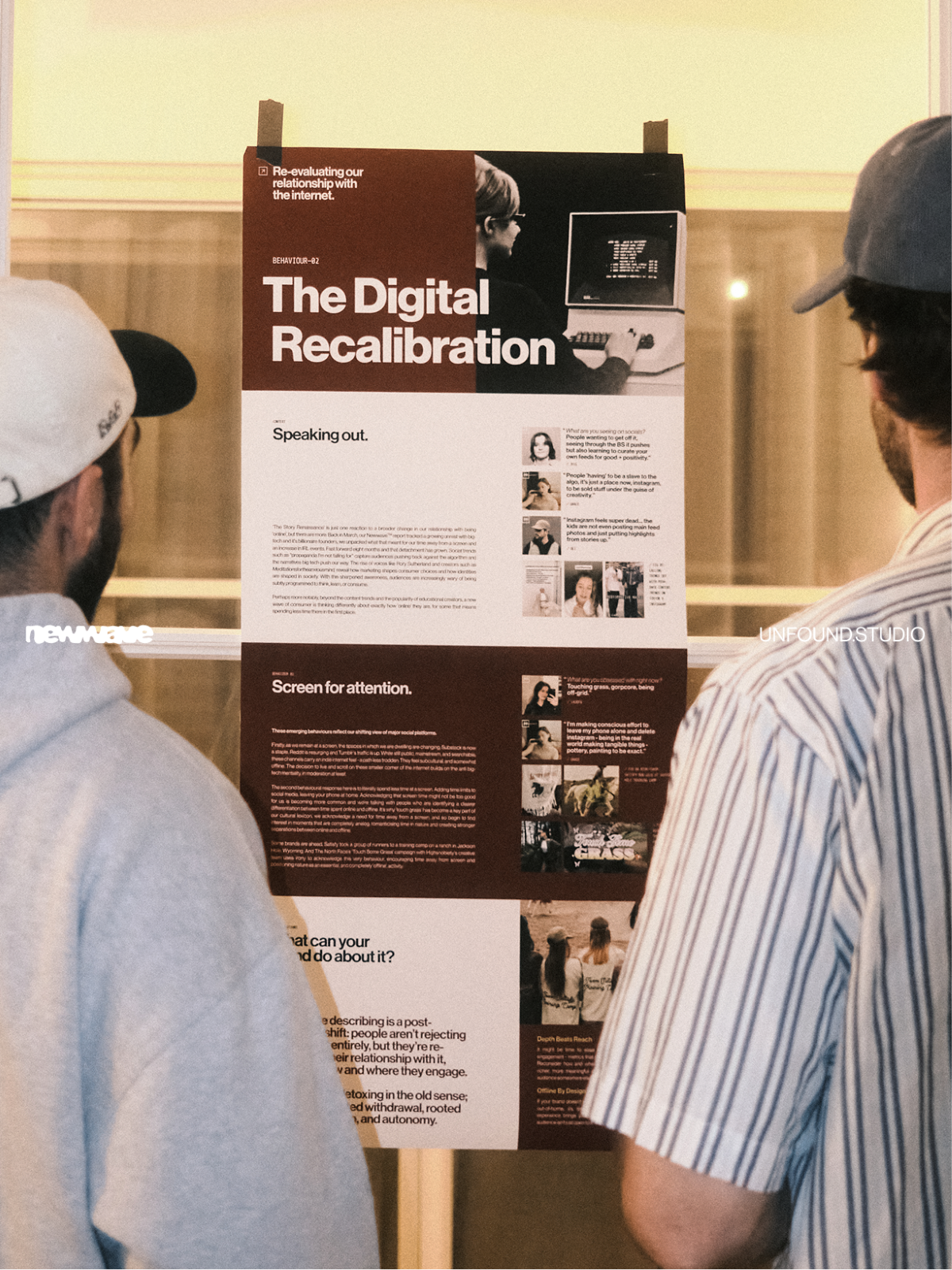
our latest report on culture, download it here
We needed a way to understand behaviour beyond demographic shorthand. Not just who people are, but what is shaping them. Newwave™ tracks cultural behaviour in real time, helping us see how expectations, beliefs, and choices shift across different life stages and moments. It allows us to understand not just what people are doing, but why.
At Unfound, Newwave™ sits at the heart of our strategy work. Before we design, write, or create, we use it to pressure-test assumptions and sense-check relevance. It helps us understand whether a message will feel reassuring or demanding, credible or tone-deaf, timely or late.
This is why our process often feels slower at the beginning. We are not rushing to solutions. We are making sure we are solving the right problem. Creative work only resonates when it responds to something real. Otherwise, it's just noise.
The brands earning trust right now are not necessarily the loudest or the most trend-aware. They are the ones that understand timing. Brands like Patagonia, which speaks to responsibility and restraint rather than constant consumption. Or IKEA, which has increasingly shifted its language toward life stages, transitions, and everyday realities, not aspirational perfection.

They don't talk to people as generations. They speak to them as humans navigating modern life.
That is why we care about age. That is why we built Newwave™. And that is why strategy comes before creative at Unfound.
hello@unfound.studio | Let’s chat